It's not insomnia, and it's not in your head. It's a contract your body renegotiated without telling you, and once you read the new terms, there's a lot you can do.
Let's get one thing straight before we go a single sentence further: this is real, you're not overreacting, and it isn't just "part of getting older." You don't need another lecture about sleep hygiene from a doctor who gave you ninety seconds and a prescription sleep aid. You need to know what actually changed, and what to do about it.
Somewhere in your late thirties or forties, your hormones quietly renegotiated the terms of your sleep. Nobody handed you the new contract. So now you fall asleep fine, and then at 3am you're wide awake, heart going a little too fast, mind suddenly very interested in every mistake you've made since 2009. Or you wake up drenched, kick off the covers, and never quite drop back under. Or you don't even feel tired when night comes, so you're somehow still up at 1am, then dragging yourself out of bed when the alarm goes off. By morning you feel like you slept in a wind tunnel, and somehow you're supposed to function. That's the bill, and nobody told you it was coming.
And whatever you do, don't talk yourself into "well, I guess this is just all the sleep I need now." I hear that one constantly, and it's one of the most expensive sentences in midlife. Your sleep need doesn't shrink as you age. What changes is your ability to get it: the nights fragment, the deep sleep thins out, and it becomes very easy to mistake "I can't" for "I don't need to." You didn't suddenly become a person who thrives on five broken hours. You became a person whose body stopped handing them over, and that's a different problem with a different answer.
This is the cruelty of how the body changes in midlife: it never announces itself. It works in the dark, at the worst possible hour, and then lets you believe the problem is you. It isn't. What feels like a personal failing is almost always a hidden mechanism. And the whole game, the entire difference between white-knuckling through and actually sleeping again, is naming the mechanism. So let's name it.
Why this is actually happening
Three things shift in perimenopause, and each one sabotages a different part of your night. Together they're a tag team.
Progesterone drops first, usually years before anything else
Progesterone is your built-in chill. Its calming byproduct works on the exact same system in your brain that anti-anxiety medications target. When it starts falling (often in your late thirties, long before your periods get weird), you lose that natural sedative. Sleep gets lighter. You wake at the smallest thing. A new, pointless anxiety shows up around 3am like an uninvited houseguest. That's not a personality change. That's a hormone leaving the building.
Estrogen stops being reliable
Estrogen helps run your thermostat and your serotonin (which your body turns into melatonin). When it swings, you get the night sweats and hot flashes that physically yank you out of deep sleep, plus a wobblier melatonin signal underneath. And in perimenopause it really swings; it doesn't politely decline. It's the volatility that gets you, not the eventual low.
Cortisol shows up at the wrong time
Cortisol is supposed to be low at night and high in the morning. Stress and shifting hormones flip that script, and it spikes when it should be quiet: the classic "wired and wide awake at 3am." Add a blood-sugar dip from that evening glass of wine or a carb-heavy dinner, and your body dumps cortisol and adrenaline to fix it. Congratulations, you're up.
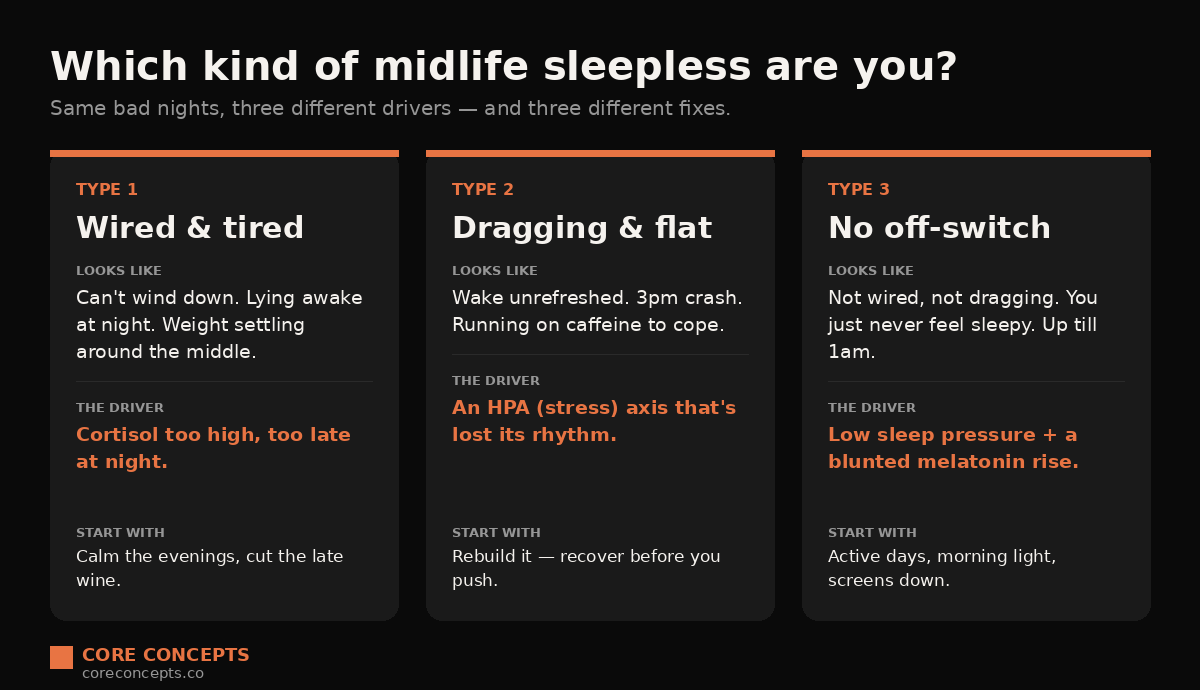
That cortisol problem shows up in two opposite ways, and it's worth knowing which is yours. The wired-and-tired version (you can't wind down, weight's settling around your middle, you lie awake at night) is high cortisol. The flip side is dragging all day, waking unrefreshed, crashing at 3pm, running on caffeine: an HPA axis (your stress system) that's lost its rhythm. A single morning blood draw won't tell them apart. A 4-point salivary cortisol test, taken at waking, noon, evening, and night, maps the whole curve and catches the inverted pattern (low in the morning, high at night) that gets common after 35. If your sleep won't budge, it's worth asking for.
And there's a third type that isn't really about cortisol at all: the woman who isn't wired and isn't dragging, she just doesn't feel tired at bedtime, so she keeps going until 1am. That's not a personality quirk, it's a missing signal. Your body needs two things to feel sleepy: enough sleep pressure built up across the day (a molecule called adenosine that accumulates the longer and more actively you're awake) and a properly timed melatonin rise at night. Caffeine blocks the first. Bright evening light, screens, a cortisol curve that's still high at night, and the plain age-related drop in melatonin all blunt the second. And if your days have gotten quieter (retirement is the classic) you may not be building enough sleep pressure to feel the pull at all. The fix isn't to lie there waiting to feel sleepy. It's to rebuild the signals: a genuinely active day, real morning light, caffeine off by early afternoon, and screens down so melatonin can actually climb.
So no, you didn't suddenly forget how to sleep. The environment that used to let you sleep through the night simply changed underneath you. That's not a character flaw. It's biology nobody bothered to explain.
Before you blame your hormones, rule out three things
Here's where most articles wave their hands and tell you it's "just menopause." But the body is a master at hiding its problems in plain sight, and three of them are common in midlife women, routinely missed, and fixable in ways no amount of lavender spray will touch. Rule these out first.
Sleep apnea, the big one
Apnea risk climbs sharply in perimenopause and menopause, because the hormones that help keep your airway and breathing drive stable are exactly the ones leaving. And here's the trap: women get under-diagnosed constantly, because we don't fit the cartoon of the snoring middle-aged man. In women it shows up as fatigue, "insomnia," and 3am waking. If you wake unrefreshed no matter how long you were in bed, wake up gasping, get morning headaches, or wake with a bone-dry mouth, ask for a sleep study. This is the single most important thing on this page to rule out, full stop.
And that dry mouth is its own clue
Waking with a mouth like sandpaper almost always means you slept with it open. Your nose is built for breathing and your mouth isn't: mouth breathing dries your airway, fragments your sleep, and makes snoring and apnea worse. It's very fixable (that's #3 below), but rule out apnea first, because the fix is genuinely dangerous over untreated apnea.
Low iron (ferritin) and restless legs
Heavy, erratic perimenopausal periods quietly drain your iron stores. Low ferritin is a major driver of restless legs and that fidgety, never-quite-deep sleep that's so easy to write off as stress. Ask for a ferritin test. The lab's "normal" floor is way too low here; you generally want it comfortably in the 50–100 range. Don't start chugging iron on a hunch, though. Test first.
Thyroid
An underactive thyroid is common in midlife women and wrecks sleep, temperature, and energy. The single TSH most doctors run misses a lot. Ask for the full panel, not just TSH: free and total T4, free and total T3, T3 uptake (or free thyroxine index), reverse T3, and both thyroid antibodies (TPO and thyroglobulin). The functional ranges to aim for are in my complete thyroid panel guide.
If any of these fit, that's a conversation with a provider, ideally one who actually knows menopause. Everything below is what moves the needle once these are off the table.
What works (in the order that matters)
Most "tips for better sleep" lists are a flat pile of twenty things with no priority, which is its own kind of useless. Here's the truth: a few of these matter enormously and the rest are rounding error. Ranked.
If you only do three things this week:
- Cut the evening wine, or at least move it earlier in the evening.
- Eat your last meal earlier, ideally finishing dinner two to three hours before bed.
- Get ten minutes of daylight in your eyes first thing in the morning.
These are the fastest-acting levers on the whole list. Everything below is the fuller picture, roughly in order of impact.
1. Rethink the evening wine
I know. I know. But alcohol is usually the single biggest sleep wrecker in this whole picture: it feels like relaxation, then it shreds the back half of your night and makes night sweats worse. In perimenopause it hits harder than it used to, and the 3am rebound is sharper because your own progesterone isn't there to soften the landing. Even cutting back a few nights a week is often the fastest win you'll feel. And on the nights you do drink, move it earlier: alcohol within about three hours of bed does the most damage to the back half of your night. (This one's so big I wrote a whole separate piece on the wine-and-3am loop. Read that next.)
2. Your coffee isn't the problem. How you drink it is.
Coffee on an empty stomach spikes cortisol, and cortisol's whole job is to raise blood sugar. Now do the classic thing and chase it with something starchy (toast, a bowl of cereal, a banana on the way out the door), and you've stacked a carb spike on top of a cortisol spike. Insulin surges to mop it up, you crash an hour or two later (shaky, foggy, suddenly starving), and that crash dumps another round of cortisol and adrenaline to haul your blood sugar back up. Now you're on a hormonal seesaw before 9am, and riding it all day keeps your cortisol from ever settling, which is the exact wired-but-tired state that won't let you sleep that night. The morning you think is unrelated to your 3am is not unrelated to your 3am. The fix is simple: eat protein and fat first (eggs, Greek yogurt, a splash of cream and a scoop of collagen right in the cup), and let the coffee and any carbs ride along with food, never solo. And since caffeine clears more slowly as you age, that 2pm cup is still in your bloodstream at bedtime, so cut it off by early afternoon. And if you're genuinely hooked, don't quit cold turkey; taper by half every few days, go half-decaf, or swap the afternoon cup for decaf green tea, whose L-theanine takes the edge off without the jitter. Same coffee, completely different day.
3. Breathe through your nose, and try mouth tape
If you wake with a dry mouth, you're mouth-breathing all night, and that alone fragments your sleep and feeds the snoring-and-apnea problem. Once apnea is ruled out (do that first; taping over untreated apnea is genuinely dangerous), a small strip of soft surgical or micropore tape across the lips keeps you nose-breathing. Start with a short vertical strip, or tape just one side if it feels claustrophobic. And if it's always congested, the reason is often on your plate (more on that below). It looks ridiculous. It also quietly fixes a lot of people's nights.
4. Train earlier
Late, hard workouts spike cortisol exactly when you want it winding down. Lift earlier in the day, and pick strength over a 9pm cardio session.
5. Guard the hours before 10
Your deepest sleep and most of your overnight repair are front-loaded into the first part of the night. Protect them: consistent sleep and wake times, a genuinely cool dark room (aim for around 60–67°F; your core temperature has to drop a degree or two to fall asleep, which is exactly what night sweats sabotage), screens down before bed, and your last real meal at least a couple of hours earlier.
6. Get light in your eyes in the morning
Daylight early sets your body clock and actually lowers your cortisol that night. It's free, it takes ten minutes, and it's absurdly underrated.
7. Steady your overnight blood sugar. This one compounds.
Here's the chain almost no one explains to you. A sugary or refined-carb dinner (or that glass of wine) spikes your insulin, and insulin shoves your melatonin down right when you're trying to fall asleep. Then, a few hours later, your blood sugar overshoots downward into a dip, and your body treats a 3am low like a five-alarm fire. It dumps cortisol and adrenaline to drag glucose back up, and that surge is what snaps you awake: wired, heart going, anxious for no reason you can point to. Do it one night and it's a rough night. Do it night after night and it trains the single worst pattern there is: cortisol that's high when it should be flat. After about 35 that inverted rhythm starts showing up on its own, and you really don't want to be feeding it from the dinner table. The fix is unglamorous: protein and fat at dinner instead of a carb avalanche, finish that dinner two to three hours before bed (eating late keeps insulin up exactly when melatonin should be climbing), ease off the late sugar and alcohol, and if you still wake at 3am, test a small protein-and-fat snack before bed for two weeks and see.
8. Actually calm your nervous system
Not as a vibe. As physiology. Breathwork, a real wind-down ritual, touch and connection all lower cortisol through your body's own chemistry. Pick one and make it a ritual; the consistency is what teaches your body the day is genuinely over.
9. Magnesium
Magnesium glycinate, taken orally, helps a lot of women settle into sleep, lowers night-time cortisol, and steadies blood sugar. That's the version with the best evidence behind it. If your gut is touchy (and most of ours are), the topical route sidesteps it: a magnesium chloride oil or spray on the skin, or a warm Epsom-salt bath before bed. Dr. Mark Sircus, who literally wrote the book on transdermal magnesium, makes the case that skin delivery beats pills precisely because it skips the gut. And a warm bath helps either way: it lowers cortisol and drops your core temperature as you cool off, both of which help you fall asleep.
10. The hormone-therapy conversation most women still get scared off
This is the one a lot of women are never offered, usually because of headlines from a twenty-year-old study that has since been heavily walked back. A menopause-literate doctor can prescribe transdermal estradiol, which calms the hot flashes and night sweats that shred the back half of your night, and bioidentical progesterone, which is genuinely sedating for many women and helps rebuild the calm you lost when your own progesterone dropped. For a lot of women this isn't a last resort; it's the single biggest lever. One nuance: with progesterone, more isn't better. Too high a dose can leave you groggy or bloated, so it's something to dial in, not max out. If you've worked the list and still can't sleep, find a provider who actually does menopause and have the conversation. And if you'd rather start at the gentlest, food-first end of supporting those same hormones, that's what seed cycling is: flax and pumpkin in the first half of your cycle, sesame and sunflower in the second, to nudge estrogen and progesterone over a few months. It won't replace hormone therapy, but it's low-risk and a fine place to begin, and I walk through the whole protocol in a separate piece.
Three complaints, one plate
Maybe you've worked the whole list above, or most of it, and your sleep still won't budge. That's the moment to look at a root the whole list doesn't touch. It rarely shows up looking like a food problem, which is why it collects three separate shrugs from three separate doctors. Almost always, it's one problem wearing three coats, and it's sitting on your plate.
When your body is reacting to a food it no longer tolerates, it inflames you in several places at once. In your sinuses and throat, as congestion and extra mucus that blocks your nose, forces you to mouth-breathe, and turns into snoring and that dry-mouth 3am wake-up. In your muscles and joints, as aches and stiffness that no amount of stretching quite resolves. And as the heavy, unrefreshing fatigue that's worst first thing in the morning.
Perimenopause turns the volume up on all of it, because the same progesterone drop and estrogen swings that wreck your sleep also wreck how you clear histamine. Progesterone steadies the cells that release histamine and supports the enzyme that breaks it down, so as progesterone falls, histamine builds, and foods you handled fine for decades start lighting you up. The usual suspects are the high-histamine and inflammatory ones: wine (again), aged cheese, fermented foods, cured meats, and for a lot of women gluten and dairy.
None of this is new, by the way. Theron Randolph mapped this exact cluster (congestion, body aches, morning fatigue from food reactions) more than fifty years ago and got written off as a crank for it; the mechanisms we'd name now (inflammation, histamine, a leaky gut in constant conversation with the immune system) have quietly caught up. He also spotted the tell: the foods most likely to turn on you are the ones you eat every single day. We used to eat seasonally and rotate by default, but big agriculture and global shipping erased that, so the same few staples (wheat, corn, soy, dairy, sugar) sit on your plate year-round with no break, which is exactly how the body sensitizes. So when you run your elimination, start with your daily staples, not the exotic stuff.
You don't even need a test for this, though a blood or saliva panel can hand you a starting list if you want one. Treat that list as a hypothesis, not a verdict: the panels aren't settled science, and the confirmation that actually counts is free. Pull the likely culprits for two to three weeks, then add them back one at a time and watch what your nose, your joints, and your sleep do. If the congestion, the aches, and the 3am waking lift together, you didn't find three coincidences. You found a root.
The Midlife Sleep Reset
Everything on this page, turned into a protocol you can actually run — the fixes in order of impact, the labs to ask for, and a simple two-week reset to test it on yourself.
- The three medical drivers to rule out first — apnea, ferritin, thyroid — and exactly what to ask for
- The fixes that move the needle, ranked by impact
- The coffee, blood-sugar, and light tweaks most advice skips
- The progesterone conversation — and who to have it with
- Your 2-week Sleep Reset — what to do and what to track
We'll email the PDF to you immediately. You'll also get occasional posts on perimenopause, sleep, training, and what most coaches miss. Unsubscribe any time.
Stop treating the symptom
At this stage of the game, melatonin and sleep hygiene work on the surface. They might help at the edges, but if your sleep fell apart in midlife, the cause runs deeper: it's hormonal, and the only real fix that lasts is the one that goes after the hormones. That's the whole difference between gritting your teeth through another bad year and getting your nights back.
So, no, you're not a bad sleeper. You're not "just stressed." Your body changed, the rulebook changed with it, and you didn't get a new one. Now you've got it. The question was never whether you could sleep again. It's whether someone finally showed you what to fix.
When you want the version built for you
Everything above is the map: what's actually going on, and what works. For a lot of women, that's enough to start getting real nights back, and I want it to be. But a map isn't the same as someone walking the trail with you. If you've got the overlapping picture (the 3am waking and the congestion and the aches), or you've worked the list and your sleep still won't move, that's exactly the knot I untangle with clients: finding which root is actually driving your version of this, and building the plan around your labs, your training, and your life.
That's the difference between what helps and what helps you. If that's where you are, let's talk. The first conversation is free.
This is the knot I help women untangle.
Better sleep, less stress, more strength, and a midlife that actually feels like yours again, by fixing the root cause instead of chasing symptoms. A free 20-minute consultation: no pressure, just a straight read on what's driving your version of this and what to do next.
Book a free consultation →