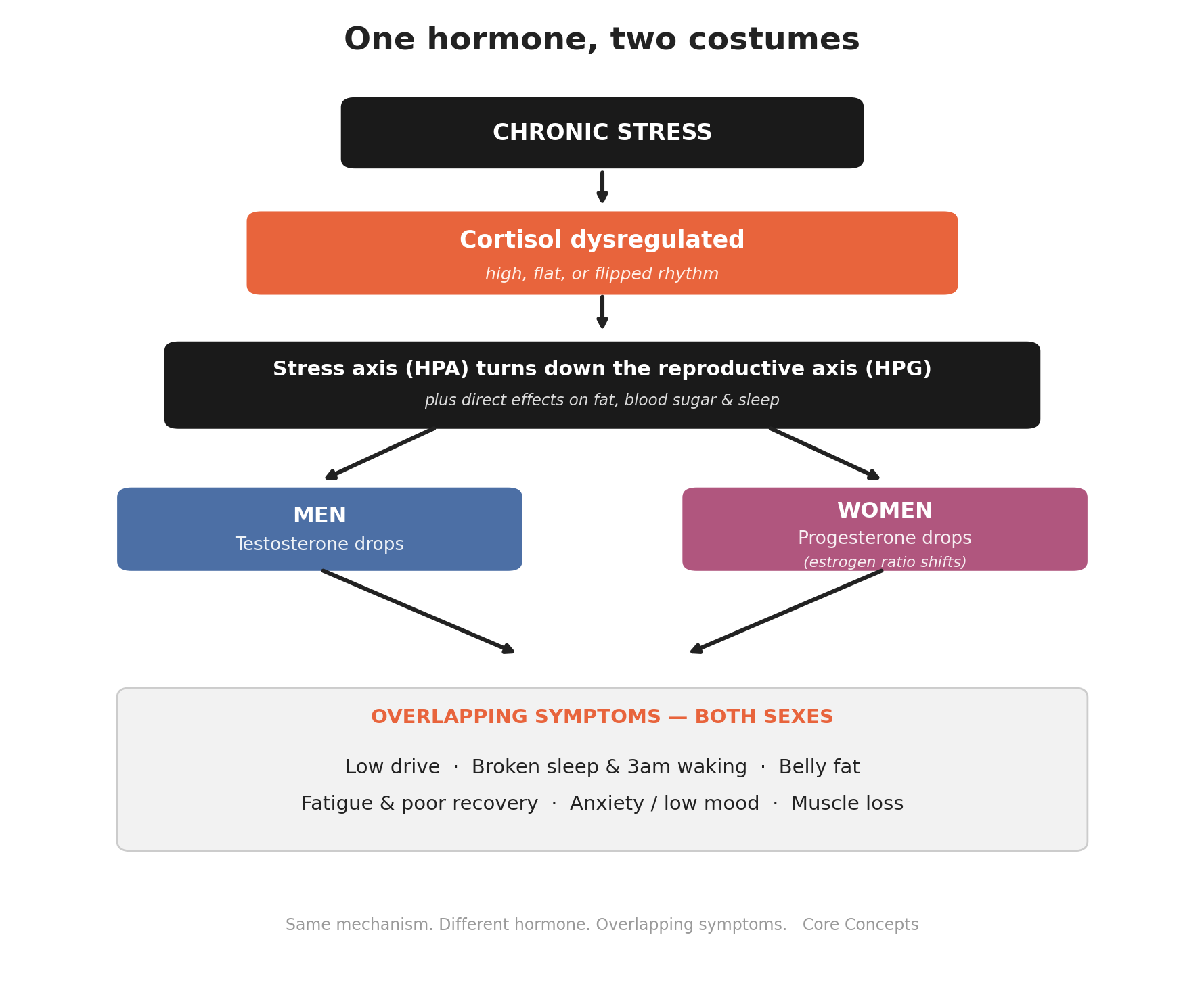
The reason she can't lose the belly and the reason he can't find his drive are, quite often, the same reason. One hormone. Two costumes. And almost nobody is checking for it, because it doesn't show up where everyone is looking.
Chronic stress raises cortisol, and sustained high cortisol suppresses the reproductive hormones in both sexes: testosterone in men, progesterone in women. The mechanism is the stress axis (HPA) turning down the reproductive axis (HPG). It produces different symptoms in each sex — thicker midsection, broken sleep, low drive, poor recovery — which is why it's rarely traced to a single cause. Standard lab panels miss it because they check thyroid, blood sugar, and cholesterol, but not the daily rhythm of cortisol. One key distinction: a single acute stressor briefly raises these hormones. It's chronic, unrelenting stress that suppresses them.
- One hormone — cortisol — sits underneath weight gain, sleep disruption, and low libido in both men and women.
- Chronic stress suppresses estrogen, progesterone, and testosterone as a group, because the body demotes reproduction during a prolonged perceived emergency (Sapolsky; confirmed by current HPA–HPG research).
- Acute vs chronic matters: a 2024 meta-analysis of 21 studies (881 people) found a single acute stressor transiently raises sex hormones. The damage comes from chronic exposure.
- Cortisol lowers testosterone, increases appetite, and drives abdominal fat, partly through an enzyme (11β-HSD1) that concentrates cortisol inside belly fat.
- A flat cortisol rhythm can be worse than a high one. A meta-analysis of 80 studies linked flatter daily cortisol slopes to worse health across 10 of 12 outcome categories.
- You can eat clean and train hard and still go backwards if the chronic stress load underneath is never addressed.
You're doing the things. You eat reasonably well. You train. And still: the sleep is broken, the middle is thicker than it used to be, the drive and the recovery are not what they were. You go in, they run the usual labs, everything comes back "within range," and you get sent home to try harder at a fight you're already losing.
There's a single hormone sitting underneath a surprising number of these complaints, and it doesn't care what sex you are. It just wears a different costume depending on who it's working on. That hormone is cortisol.
Cortisol is not the villain here, and it's worth saying that up front. You need it: it wakes you up in the morning, powers you through hard training, manages inflammation, and keeps you alive in a genuine emergency. The problem is never that you have cortisol. It's cortisol that stays switched on long after the threat has passed, day after day, for years.
Does chronic stress affect men and women the same way?
Yes. Chronic stress affects both sexes through the same hormone, cortisol, but it shows up as different symptoms. This is one of the most established ideas in the stress literature. Robert Sapolsky built a career on it, and current research on the HPA and HPG axes continues to confirm it.
The stress response is designed for a short emergency. When it fires, the body makes a fast triage decision: pour out energy, sharpen the senses, and shut down anything that isn't survival-critical right now. Digestion waits. Immunity waits. And reproduction waits. On Sapolsky's own list of what gets switched off during stress, three hormones sit together: estrogen, progesterone, and testosterone.
The body does not suppress "the woman hormone" or "the man hormone." It suppresses the reproductive hormones as a category, because to a nervous system that thinks it's being chased, building a baby, a muscle, or a sex drive is a luxury it can't afford this second. So the woman's progesterone drops first, the man's testosterone drops, they arrive with different-sounding complaints, and it's the same mechanism wearing two costumes.
One caveat worth stating plainly: the hormone that drops is sex-specific, but the symptoms are not. Broken sleep and 3am waking, low drive, belly fat, fatigue, and low mood show up in both men and women. What differs most is the hormone underneath, and the label each person is handed: "perimenopause" for her, "just getting older" for him.
Does short-term stress lower your hormones too, or only chronic stress?
Only chronic stress suppresses them. This is the distinction most articles get wrong. A 2024 systematic review and meta-analysis titled "Gonads under stress" pooled 21 studies and 881 people and found that a single acute laboratory stressor actually stimulates the reproductive axis short-term, briefly raising testosterone, progesterone, and estradiol rather than lowering them.
That's not a contradiction. It's the whole point. A short stressor gives you a quick hormonal bump, the same way a sprint away from danger is supposed to. The problem is the stressor that never ends: the job, the caregiving, the under-eating, the poor sleep, the training with no recovery. Sustained cortisol is what turns the reproductive axis down and keeps it down. One hard day doesn't do this. A hard decade does.
Does cortisol lower testosterone in men?
Yes. Sustained high cortisol suppresses testosterone, which shows up as lower drive, less muscle, more fatigue, and increased body fat. The mechanism is well documented: chronic stress and elevated glucocorticoids inhibit the GnRH and gonadotropin signals that tell the testes to produce, and chronically elevated cortisol is associated with reduced testosterone and even male infertility in the current literature. Shawn Talbott, who wrote an entire book on cortisol, argues that "eat less, exercise more" fails most people precisely because of this: chronic stress raises cortisol, and elevated cortisol lowers testosterone while raising appetite and pushing fat toward the abdomen.
This is why men in their 40s and 50s often describe the exact cluster: the workouts stop working, the belly arrives despite the same diet, and the drive quietly fades. It's not "just aging." It's a measurable hormonal shift with a name.
Does stress lower progesterone in women?
Yes, chronic stress lowers progesterone in women, but the popular explanation for how is wrong. You'll often hear it called "pregnenolone steal": the idea that the body diverts a shared pool of the precursor hormone toward cortisol and away from progesterone. That mechanism doesn't hold up. Steroid hormones are made locally inside each gland (adrenal, ovary) from cholesterol, and there's no shared pregnenolone pool that transfers between them.
The real mechanism is cleaner and better supported: the stress axis (HPA) suppresses the reproductive axis (HPG). Sustained cortisol and its upstream signals turn down the hormonal messages that tell the ovaries to produce, which can disrupt ovulation and lower progesterone. In its extreme form this is functional hypothalamic amenorrhea, where chronic stress and under-fuelling shut down the cycle entirely. Current research also shows cortisol reactivity runs higher in the luteal phase, exactly when many women feel worst. The practical result is what women describe in perimenopause: the sleep fragments, the 3am waking arrives, the calm that progesterone provides thins out.
Estrogen is affected too, just less cleanly than progesterone. Progesterone tends to drop first and fastest, so the estrogen-to-progesterone balance tips (often called relative estrogen dominance), which brings its own set of symptoms. In severe or prolonged stress, estrogen falls as well, alongside progesterone. So the picture in women is rarely simply high or low estrogen. It's more often a ratio that has shifted, which is one reason it's so easy to miss on a single hormone reading.
Why does stress cause belly fat specifically?
Stress drives fat to the midsection because abdominal fat is uniquely sensitive to cortisol. An enzyme called 11β-HSD1, concentrated in belly fat, liver, and brain, reactivates cortisol locally inside the cells. This means you can have "normal" cortisol in your blood and still be marinating your midsection in it. The research is striking: 11β-HSD1 activity correlates with visceral fat and insulin resistance, mice engineered to overexpress it in fat develop full metabolic syndrome, and mice lacking it resist diet-induced weight gain. It's now studied as a drug target for exactly this reason. The fat depot amplifies the very hormone that put it there, which is why the middle is so stubborn even when the rest of you is leaning out.
There's a second layer to this. Cortisol also raises blood sugar on purpose, because in a real emergency you need fuel in the bloodstream to fight or run. When the emergency never ends, that blood sugar has nowhere to go, so insulin rises to store it, and chronically elevated insulin is itself a fat-storage signal. Cortisol and insulin end up working together: cortisol keeps sending sugar into the blood, insulin keeps packing it away, and the preferred storage site is the visceral fat around your organs. This is why the midsection weight so often arrives alongside the "slightly high" blood sugar your doctor mentioned but didn't act on. They're not two separate problems. They're the same stress cascade showing up on two different lines of your lab report.
What does chronic stress actually look like day to day?
Chronic stress rarely feels like the word "stress." Most people picturing a stressed person imagine someone frantic and overwhelmed. The physiology that drives this cascade is often much quieter, and it hides in routines that look responsible.
It looks like waking at 3am and lying there wired but exhausted. Needing coffee to start the day and a drink to stop it. Training hard six days a week, eating carefully, and watching the scale refuse to move or creep the wrong way. A short fuse over small things, a libido that quietly left without a note, a level of tired that sleep does not fix. Often it's the person who "handles everything": the caregiver, the high performer, the one who hasn't had a genuine day off in years. None of that reads as a medical problem. All of it is the nervous system stuck in the on position, and cortisol is the hormone keeping it there.
The reason this matters is that the people most affected are usually the ones least likely to call themselves stressed. They're functional. They're coping. And the coping is the problem, because a body that never gets the all-clear never resets.
Can you have high cortisol with normal lab results?
Yes, and this is the part that keeps people stuck. It's not always about cortisol being sky-high. It's usually about the rhythm. A healthy cortisol curve is highest in the morning to get you up and moving, then falls steadily through the day to its lowest point at night so you can sleep. Two dysregulated patterns break that curve.
The first is a flat rhythm: cortisol that never really rises when you need it and never really drops when you should be winding down. Steady, moderate exposure, all day and all night.
The second, and one a lot of people actually have, is a flipped rhythm: low in the morning, when you should be alert, and elevated at night, when you should be calm. This is the "tired but wired" pattern. You drag yourself out of bed and need caffeine to become a person, then you get a strange second wind in the evening and lie there at 11pm unable to switch off. On a single mid-morning blood draw, a flipped rhythm can look completely normal, or even low, while the real problem is happening at 10pm.
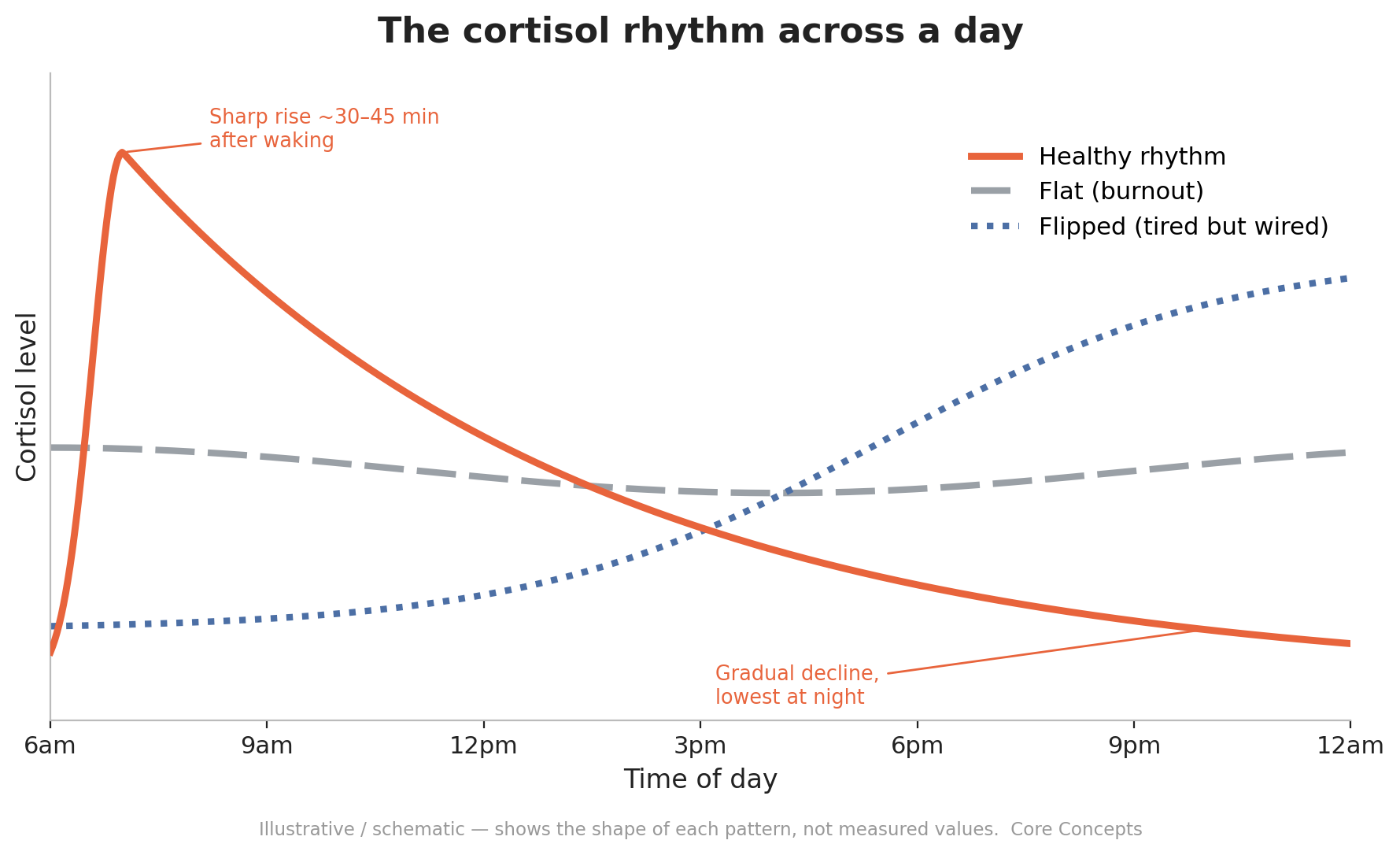
The data here is strong. A meta-analysis of 80 studies covering 179 separate associations found that a flatter daily cortisol slope predicts worse health across 10 of 12 outcome categories, with the strongest links to immune and inflammatory problems, and an associated increase in mortality risk. Later work has tied dysregulated daily cortisol to cardiovascular mortality specifically. And all of it hides inside a "normal range" on a single blood draw.
Your standard visit checks your thyroid, your blood sugar, and your cholesterol. It rarely takes a serious look at your stress axis, even though it's quietly steering all three. If you want to actually see the rhythm, the test to ask for is a 4-point salivary cortisol across a day. A hormone whose entire job is to change across 24 hours cannot be captured in one reading.
Does alcohol or caffeine make cortisol worse?
Yes, and this is where two of the most common coping tools quietly backfire. Alcohol is the classic example. A drink in the evening does help you fall asleep faster, which is exactly why people reach for it, but as it clears from your system in the small hours it triggers a rebound: fragmented sleep, suppressed deep sleep, and a rise in stress hormones that often lands you awake around 3am. The nightcap that was supposed to calm you down is one of the reasons you can't stay asleep, and broken sleep drives cortisol higher the next day. It's a loop.
Caffeine plays a similar game earlier in the day. It directly raises cortisol, and when you use it to paper over the fatigue that a flat cortisol rhythm produces, you push your own stress hormone higher while masking the signal that something's wrong. Late-day caffeine then delays the evening cortisol drop you need in order to sleep. Neither of these means you can never have coffee or wine again. It means that if your rhythm is already dysregulated, these two inputs are pouring fuel on it, and pulling them back is often the fastest lever available.
What actually lowers cortisol?
The inputs that keep cortisol chronically high are things you can change without a prescription: how much you eat, how hard and how often you train, how you sleep, how much stimulant and alcohol you use, and whether your nervous system ever gets the signal that the emergency is over. Under-eating raises it. Over-training raises it. Broken sleep raises it. A day that never has an off-switch keeps it flat and high.
- Eat enough. Get enough protein and total food to signal safety rather than famine. Under-eating reads to the body as an ongoing emergency and keeps cortisol elevated.
- Train to build, not to deplete. For most people who are already stressed, that means more strength work, genuine recovery days, and less relentless high-intensity cardio on an already-taxed system.
- Fix light and sleep. Daylight in your eyes within an hour of waking, a real wind-down at night, and stop using alcohol to force the downshift your nervous system should do on its own.
- Pull the fuel off the fire. Cut back late-day caffeine and evening alcohol, the two inputs most likely to be keeping an already-dysregulated rhythm lit.
- Build in a real off-switch. Slow nasal breathing with a long exhale, unhurried walks, and the vagus-nerve techniques below are direct, immediate levers on the branch of the nervous system that turns the stress response off.
- Test the rhythm instead of guessing. Ask for a 4-point salivary cortisol across a day so you can see whether yours is flat, flipped, or high, rather than working blind.
These aren't soft add-ons. They're the actual inputs that decide whether your stress physiology stays switched on or finally stands down. The symptom that shows up loudest is almost never the thing that needs fixing. The thick middle, the broken sleep, the missing drive: those are the smoke. Cortisol is closer to the fire. None of this is a character flaw. It's a physiology that got stuck in overdrive, and it responds when you change the inputs feeding it.
How do you activate the vagus nerve to calm the stress response?
You activate the vagus nerve most directly by slowing your exhale, because the vagus is the main nerve of the parasympathetic ("rest and digest") system and it slows the heart on every out-breath. The vagus nerve runs from the brainstem through the throat, heart, lungs, and gut, and it's the physical brake on the stress response. When it's working well, heart rate rises slightly on the in-breath and falls on the out-breath — a pattern called respiratory sinus arrhythmia and a marker of healthy heart rate variability (HRV). A longer exhale is one of the few levers you can consciously press to shift the nervous system out of fight-or-flight in real time.
Stephen Porges described this system in his polyvagal theory, which frames the autonomic nervous system as a hierarchy of states: a calm, socially engaged state at the top (ventral vagal), a mobilized fight-or-flight state in the middle (sympathetic), and a shutdown or freeze state at the bottom (dorsal vagal). The specific evolutionary claims in polyvagal theory are debated among researchers, but the underlying vagal physiology and the practical techniques that raise vagal tone are well supported.
The Basic Exercise: a 2-minute vagus nerve reset
This eye-position exercise is drawn from Stanley Rosenberg's clinical work applying polyvagal theory:
- Lie on your back and interlace your fingers behind your head, cradling the base of your skull where it meets the neck.
- Keep your head completely still and move only your eyes to the right, as far as is comfortable.
- Hold your gaze there until you spontaneously sigh, swallow, or yawn. This often happens within a minute, but can take several minutes longer if you're very wound up, so don't rush it. That reflex, whichever one shows up, is the sign your nervous system has shifted state.
- Return your eyes to center, rest, then repeat looking to the left.
Other simple ways to raise vagal tone
A few practical techniques stimulate the same calming branch: exhaling for longer than you inhale (for example, a four-count in and a six- to eight-count out), humming, singing, or gargling (the vagus supplies the muscles of the throat), and splashing cold water on the face. None of these require equipment, and they can be used in real time when you notice yourself stuck in a wound-up state.
The Cortisol Rhythm Reset
Everything on this page, turned into a protocol you can actually run — the inputs that restore your cortisol rhythm in order of impact, the labs to ask for, and a simple two-week reset to test it on yourself.
- The 6 highest-leverage inputs that lower cortisol — ranked by impact
- The one test that actually shows your rhythm (and how to read flat vs flipped vs high)
- The eat-enough, train-to-build, and light-and-sleep protocol in plain steps
- The vagus-nerve reset and the 60-second off-switches
- Your 2-week Cortisol Rhythm Reset — what to do and what to track
We'll email the PDF to you immediately. You'll also get occasional posts on hormones, stress, sleep, training, and what most coaches miss. Unsubscribe any time.
Frequently asked questions
Is cortisol the same in men and women?
Yes. Cortisol is the primary stress hormone in both sexes and works the same way. What differs is the downstream casualty: testosterone in men, progesterone in women.
Does acute stress lower testosterone and progesterone?
No. A 2024 meta-analysis of 21 studies found that a single acute stressor briefly raises reproductive hormones. It's chronic, sustained stress that suppresses them.
Can you fix high cortisol with diet and exercise alone?
Often the drivers are dietary and lifestyle inputs — under-eating, over-training, poor sleep, no recovery — which are directly changeable. But "eat less, move more" is usually the wrong prescription, because under-eating and over-training raise cortisol rather than lower it.
What test shows a cortisol problem?
A 4-point salivary cortisol measured across a day shows the rhythm. A single blood draw does not, because cortisol is supposed to change hour to hour.
Is "pregnenolone steal" real?
The outcome it describes (stress lowering sex hormones) is real. The proposed mechanism — a shared precursor being stolen — is not how steroid production works. The accurate mechanism is the stress axis (HPA) suppressing the reproductive axis (HPG).
Does stress cause high blood sugar too?
Yes. Cortisol raises blood sugar by design, to fuel a fight-or-flight response. Under chronic stress that sugar stays elevated, insulin rises to store it, and the combination promotes visceral fat and can push blood sugar toward the pre-diabetic range.
Why do I wake up at 3am?
Common contributors are an evening drink clearing your system and triggering a stress-hormone rebound, and a blood-sugar dip overnight. Both are tied to the same cortisol and blood-sugar dysregulation, which is why the 3am waking so often travels with the other symptoms.
What is the fastest way to calm the stress response?
Lengthen your exhale. A slow out-breath — longer than the in-breath — directly engages the vagus nerve and slows the heart within seconds. Humming, singing, gargling, and cold water on the face work through the same calming branch.
Is polyvagal theory scientifically proven?
The vagal physiology it draws on — parasympathetic control, heart rate variability, the calming effect of a slow exhale — is well established. Some of the specific evolutionary claims in Stephen Porges's polyvagal theory are debated. The practical breathing and vagal-tone techniques work regardless of that debate.
This is the knot I help people untangle.
If your sleep, your shape, or your recovery have shifted and nobody has given you a real answer, this is exactly what I work on with clients: the food, training, sleep, and stress inputs actually driving it — not another round of "eat less, move more." A free 20-minute consultation, and a straight read on what's running the show.
Book a free consultation →Sources: Robert Sapolsky, Why Zebras Don't Get Ulcers; Shawn Talbott, The Cortisol Connection; Sara Gottfried, The Hormone Cure; "Gonads under stress" systematic review and meta-analysis (2024, 21 studies, 881 participants); meta-analysis of diurnal cortisol slope and health outcomes (80 studies, 179 associations); research on 11β-HSD1, visceral fat, and insulin resistance; Stephen Porges, The Polyvagal Theory, and Stanley Rosenberg, Accessing the Healing Power of the Vagus Nerve. "Pregnenolone steal" is presented as metaphor; the mechanism described is HPA-axis suppression of the HPG axis. Polyvagal theory's specific evolutionary claims are debated, but the vagal physiology and breathing techniques described are well supported.